Ishizuka Sagen taught that "if your diet is unhealthy, your mind and body will also become abnormal, and if your diet is healthy, both your mind and body will be normal."
The healthy diet that Sagen speaks of is for people to follow their natural duty as granivores and to eat mainly unrefined grains that are appropriate for the region. In Japan, this means eating mainly brown rice.
Brown rice has bran on it, and as the Chinese character for bran (糠) is a combination of the character for rice (米) and the character for health (康), eating rice with the bran will make you healthy. On the other hand, white rice (白米) is white (白) and is a residue (粕), so eating white rice is the same as eating something with low nutritional value.
Sagen pointed out that the reason for the increase in the number of sick people in Japan after the Meiji Restoration from 1868 was that the culture of eating white rice spread throughout the country, and that people also began to regularly eat white bread made from wheat that is high in potassium. Sagen feared that if people's diet became abnormal, their minds and bodies would become abnormal, and the nation would also become abnormal.
Why did the Japanese, who used to mainly eat brown rice, start eating white rice and white bread, and even indulge in rich meat, lots of vegetables, and colorful sweets? It is because people seek out delicious, oily, and beautiful foods, and become obsessed with pleasing the eyes and mouth, and dislike foods that nourish the body and mind. Sagen predicted that if Japanese people living in Japan during the Meiji period regularly ate less salty vegetables and meat like Westerners, not only would it harm their bodies and minds, but it would also lead to the incidence of incurable diseases, which would increase year by year.
The above is the main point of the second chapter of "Food for Healthy Living."
Just as Sagen predicted over 100 years ago, medical expenses in Japan today are increasing year by year with no sign of stopping. Currently, annual domestic medical expenses exceed 45 trillion yen. Compared to the Meiji period when Sagen was alive, Japanese food today has become even more Westernized, and tropical spices and fruits have become commonplace, so it is no exaggeration to say that traditional Japanese foods have been blown away. Is it really okay to continue like this?
I think that we Japanese people should stop for a moment and think seriously about what we should be eating.
Sagen left behind the teaching that people should eat brown rice, but in today's society, there are probably few families who would adopt this approach, as cooking it is time-consuming and people are not accustomed to eating it. However, if more and more families start cooking and eating brown rice, with the casual attitude of just giving it a try, it could lead to a rediscovery of the benefits of eating brown rice.
I didn't even know about brown rice until I was 26 years old. I happened to come across a book that talked about the benefits of brown rice in a bookstore, and when I tried it, I found it quite delicious. In fact, because it was so chewy, I began to feel that soft white rice was not satisfying. Since then, I have eaten brown rice or 50% polished rice whenever I can cook for myself.
I do not want to recommend eating only brown rice, but I do think that we should reconsider our diet by starting from what our staple food should be.
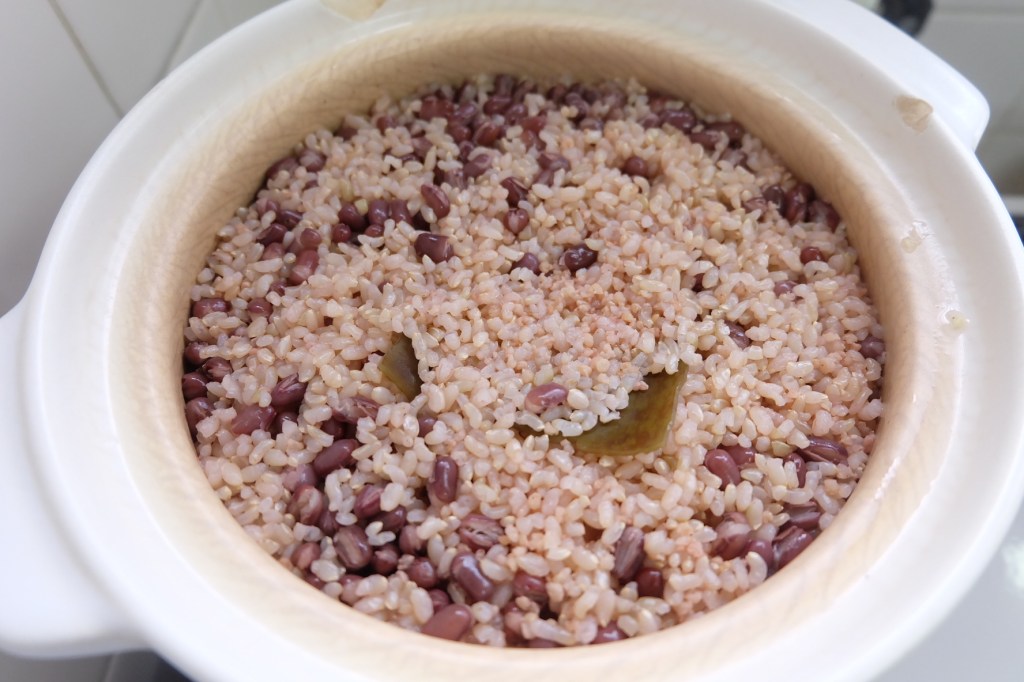
The photo shows brown rice with red beans cooked in a clay pot. When cooked in a clay pot, brown rice turns out fluffy and delicious even when cooled.
Source: Healthy Foods (published by Rural Culture Association, annotated by Hiroshi Maruyama, translated by Masanori Hashimoto)
17th, Oct, 2024: Taka
コメント
コメントを投稿